

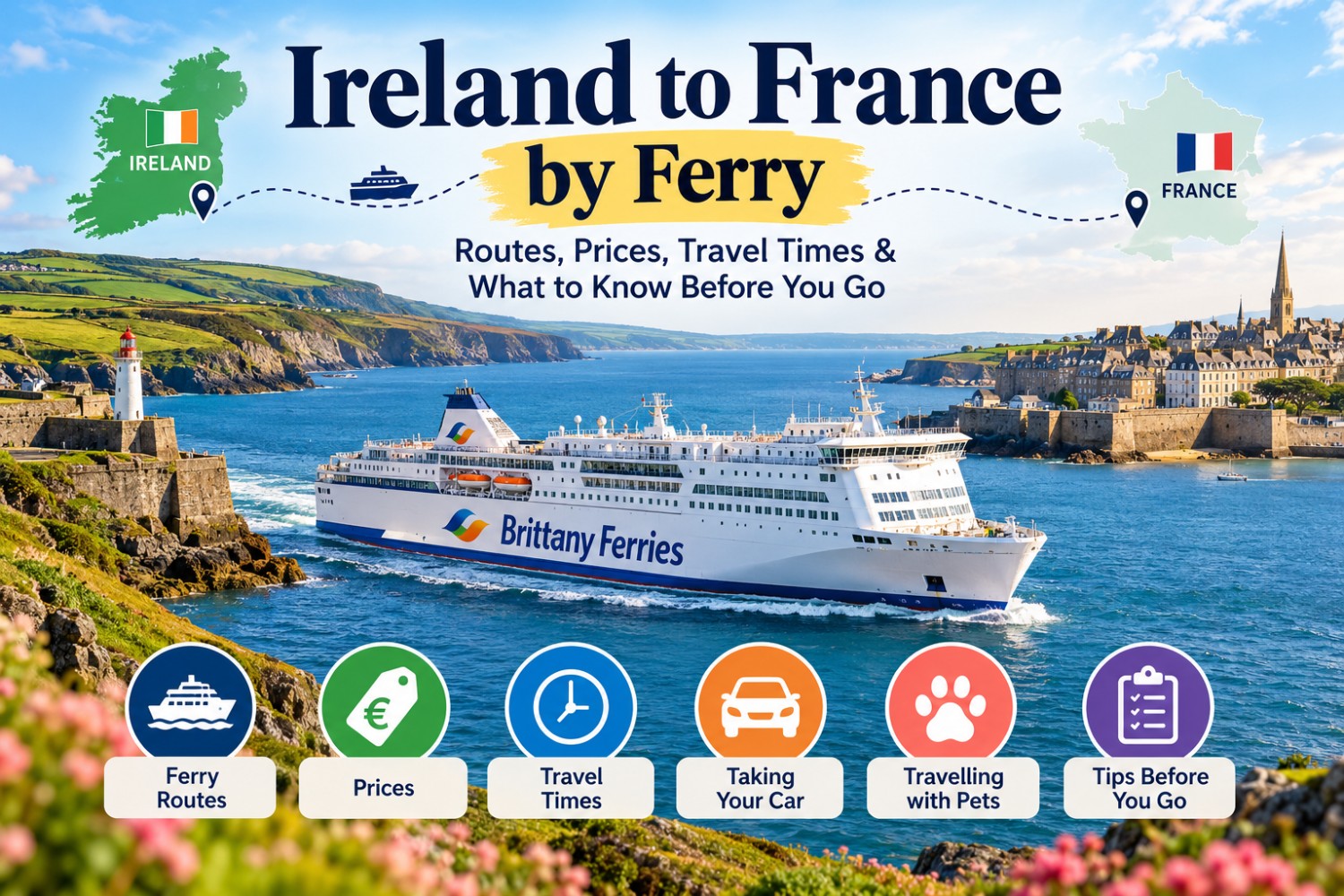
Planning a trip from Ireland to France? Travelling by ferry can be a convenient alternative to flying, particularly if you want to take your car, bring more luggage or travel with your pet. With direct ferry services from Ireland to France, you can arrive in Brittany or Normandy and continue your journey by road.
For travellers considering Brittany Ferries, there are currently two direct routes between Ireland and France: Cork to Roscoff and Rosslare to Cherbourg.
In this guide, we’ll cover the routes, journey times, indicative ferry prices, what is included, travelling with a car or pet, and what to know before booking.
Ireland to France Ferry Routes
There are two direct Brittany Ferries routes connecting Ireland with France.
| Route | Irish Port | French Port | Approx. Sailing Time | Best For |
|---|---|---|---|---|
| Cork – Roscoff | Cork | Roscoff | Around 14–15 hours | Brittany, western France |
| Rosslare – Cherbourg | Rosslare | Cherbourg | Around 17–20 hours | Normandy, Paris, Loire Valley |
Schedules are seasonal and can change, so travellers should check the timetable for their specific travel date before booking.
1. Cork to Roscoff Ferry
The Cork to Roscoff ferry is a popular option for travellers heading to Brittany and western France.
Brittany Ferries currently operates the route twice a week, with afternoon departures from Cork and overnight crossings arriving in Roscoff the following morning. The crossing takes approximately 14–15 hours.
The route is served by ships including Pont-Aven and Armorique, depending on the sailing schedule.
Why choose Cork to Roscoff?
This route can be particularly convenient if you’re planning to explore:
- Brittany
- Saint-Malo
- Brest
- Quimper
- Nantes
- Loire Valley
- Western France
One of the biggest advantages is that you can bring your own car and continue your holiday directly from Roscoff rather than arranging airport transfers or hiring a vehicle.
What’s onboard?
Depending on the ship, facilities can include:
- Cabins
- Restaurants and cafés
- Bars
- Cinemas
- Children’s entertainment
- Wi-Fi
- Lounges
- Shopping
- Swimming pool on Pont-Aven
- Outdoor decks
The overnight sailing also means you can sleep during the crossing and arrive in France ready to start your road trip.
2. Rosslare to Cherbourg Ferry
The Rosslare to Cherbourg route is another direct option and can be particularly useful for travellers heading towards Normandy, Paris or the Loire Valley.
Brittany Ferries currently operates this route four times a week, with overnight sailings generally taking around 17–20 hours from Rosslare to Cherbourg. Return crossings can take approximately 15–18 hours depending on the sailing.
Rosslare is also approximately 2 hours and 15 minutes by road from Dublin, making it accessible for travellers starting their journey in the capital.
Why choose Rosslare to Cherbourg?
This route is worth considering if you’re planning to visit:
- Normandy
- Cherbourg
- Bayeux
- Caen
- Rouen
- Paris
- Loire Valley
- Northern and central France
It’s also a useful starting point for a longer French road trip.
How Much Does the Ireland to France Ferry Cost?
Ferry prices vary according to factors such as your travel dates, route, number of passengers, vehicle type, accommodation and availability. Therefore, there isn’t one fixed price for an Ireland-France ferry ticket.
However, current Brittany Ferries promotional fares give a useful indication of what travellers may pay.
For example, a current 3-day France break is advertised from €292 return for a standard car and two people on either Cork–Roscoff or Rosslare–Cherbourg. A family option for two adults and two children starts from €368 return.
A current 5-day break starts from €312 return for a car and two people, while the family option starts from €388.
For a longer trip, the current 7-day promotional fare starts from €342 return for a car and two people, or €418 for two adults and two children.
Example promotional fares
| Trip | Car + 2 People | Car + 4 People |
|---|---|---|
| Up to 3 days | From €292 | From €368 |
| Up to 5 days | From €312 | From €388 |
| Up to 7 days | From €342 | From €418 |
These are promotional prices rather than guaranteed standard fares. They are subject to availability, sailing schedules and the terms of each offer. Cabin accommodation is extra, and additional charges can apply for larger vehicles, extra passengers and trailers.
Tip: If your dates are flexible, compare several sailing dates before booking. Ferry fares can vary considerably depending on demand and availability.
What Is Included in the Ferry Price?
What is included depends on the fare you choose, but promotional fares can include the ferry crossing, the specified passengers and a standard-sized vehicle.
For example, Brittany Ferries’ current promotional offers are based on a standard car up to 5 metres long and 1.83 metres high. Cabin accommodation is not included in those advertised prices.
It’s therefore important to check the full booking breakdown before paying, especially if you’re travelling with:
- A large SUV or van
- A caravan
- A trailer
- A motorcycle
- Additional passengers
- A pet
- A cabin requirement
How Long Is the Ferry from Ireland to France?
The sailing time depends on your chosen route.
Cork to Roscoff
The journey takes approximately 14–15 hours, with afternoon departures and overnight crossings available on the current schedule.
Rosslare to Cherbourg
The crossing generally takes approximately 17–20 hours when travelling from Rosslare to Cherbourg.
Although the ferry is considerably slower than flying, the journey can be more convenient for a road trip because you can take your own car and luggage with you.
Can You Take Your Car from Ireland to France?
Yes. Taking your car is one of the biggest advantages of travelling by ferry.
Instead of flying to France and hiring a car after arrival, you can drive directly from your home in Ireland to the ferry port, board the ship and continue driving once you reach France.
This can be particularly useful for:
- Family holidays
- Camping trips
- Road trips
- Longer holidays
- Travelling with children
- Carrying sports equipment
- Travelling with pets
It also gives you greater flexibility once you arrive in France.
Before booking, make sure you enter your vehicle’s correct length and height, as additional charges can apply to vehicles outside the standard dimensions.
Is It Better to Fly or Take the Ferry to France?
The best option depends on the type of holiday you’re planning.
Ferry travel can be better if:
- You want to take your own car
- You’re travelling as a family
- You have lots of luggage
- You’re planning a road trip
- You want to bring your pet
- You prefer overnight travel
- You want to avoid airport queues
Flying may be better if:
- You are travelling for only a few days
- You don’t need a car
- You are travelling alone
- Your destination is far from the ferry port
- You prioritise the shortest possible travel time
For a traditional French road trip, however, the ferry can turn the journey itself into part of the holiday.
What Is It Like on a Brittany Ferries Crossing?
An overnight ferry crossing is more than simply getting from Ireland to France.
On selected ships, passengers can enjoy restaurants, cafés, bars, cinemas, lounges, entertainment and outdoor areas. Pont-Aven, for example, offers facilities including restaurants, cinemas, a swimming pool, lounges and a piano bar.
For overnight crossings, booking a cabin can make the journey much more comfortable. Brittany Ferries offers two- and four-berth cabins on the Cork–Roscoff service.
If you’re travelling with young children, a cabin can also provide somewhere quiet to sleep during the crossing.
Can You Take a Pet from Ireland to France?
Yes, pets can travel on Brittany Ferries, but you need to prepare the correct documentation and follow the relevant pet-travel rules.
Depending on the sailing and booking, pets may travel in designated pet accommodation, kennels or pet-friendly cabins. Pets are not permitted in ordinary public areas or non-pet-friendly cabins.
For pet travel, Brittany Ferries advises checking requirements including:
- Microchipping
- Rabies vaccination
- Appropriate pet passport or Animal Health Certificate
- Required documentation
- Suitable accommodation
- Muzzle requirements for dogs
Dogs must be muzzled when outside their vehicle, kennel or pet-friendly cabin, according to the operator’s current guidance.
Current promotional fares advertise pet travel from €55 each way, although the exact cost and availability can depend on the sailing and accommodation selected.
What Travel Documents Do You Need?
Your travel documents depend on your nationality and immigration status.
Ireland is not part of the Schengen Area, while France is. Irish citizens travelling to France should carry a valid passport; Irish passport cards can also be used for travel within the EU/EEA, Switzerland and the UK.
If you are a non-EU national living in Ireland, don’t assume that an Irish residence permit automatically gives you permission to enter France. Visa requirements depend on your nationality and circumstances. The EU’s official travel guidance recommends checking the specific requirements before travelling.
It’s also worth checking your passport validity, travel insurance and healthcare arrangements before departure.
Don’t Forget the EU ETS Surcharge
One additional cost travellers should be aware of is the EU Emissions Trading System (ETS) surcharge.
Brittany Ferries applies an ETS surcharge to bookings on its EU routes. The amount depends on factors including the number and age of passengers, sailing length, vehicle type and travel date.
For example, Brittany Ferries currently gives a 2026 example of €47 for two adults and a car travelling Cork to Roscoff, consisting of €6 per adult plus €35 for the car. The surcharge can change, so the final booking price should always be checked before payment.
Tips for Booking an Ireland to France Ferry
1. Book early for popular dates
Summer holidays, school breaks and weekends can be busy. Booking earlier gives you a better chance of finding your preferred sailing and cabin.
2. Compare both Irish departure ports
If you’re flexible, compare Cork–Roscoff and Rosslare–Cherbourg.
Your choice should depend not just on the ferry price but also on how far you need to drive to the Irish port and where you want to travel in France.
3. Consider an overnight crossing
An overnight sailing can save you a night’s hotel cost and lets you arrive in France ready for your road trip.
4. Book a cabin for overnight travel
A cabin costs extra, but it can make a long crossing considerably more comfortable.
5. Check your vehicle dimensions
Don’t automatically assume that an SUV, campervan or van qualifies as a standard car. Vehicle dimensions can affect the fare.
6. Check pet requirements well in advance
Pet documentation and vaccination requirements can take time to arrange. Don’t leave this until the day of departure.
7. Check the final price before paying
Promotional fares are subject to availability and may exclude cabins or additional charges.
Which Ireland-France Ferry Route Should You Choose?
The choice largely comes down to your starting point and destination.
Choose Cork to Roscoff if:
You live in or around Cork and want to explore Brittany or western France.
Choose Rosslare to Cherbourg if:
You’re travelling from Dublin or elsewhere in eastern/central Ireland and want easy access to Normandy, Paris or the Loire Valley.
Both routes allow you to take your car and turn your journey into a French road trip.
Frequently Asked Questions
How long is the ferry from Ireland to France?
Cork to Roscoff takes approximately 14–15 hours, while Rosslare to Cherbourg generally takes around 17–20 hours.
How much is the ferry from Ireland to France?
Current promotional fares start from €292 return for a car and two people for a short break, although prices vary according to dates, availability, route and accommodation.
Can I take my car from Ireland to France?
Yes. Both Cork–Roscoff and Rosslare–Cherbourg are suitable options for travellers taking their vehicles to France.
Can I take my dog on the ferry?
Yes, pets can travel on Brittany Ferries subject to the applicable booking options and pet-travel requirements.
Is Cork or Rosslare better for travelling to France?
It depends on your starting point and final destination. Cork–Roscoff is particularly useful for Brittany and western France, while Rosslare–Cherbourg provides convenient access to Normandy and destinations further inland.
Do I need a passport to travel from Ireland to France?
Irish citizens should carry a valid passport when travelling from Ireland to France. Requirements differ for non-EU nationals, so check the official rules for your nationality before travelling.
Final Thoughts
Travelling from Ireland to France by ferry is a practical option for anyone planning a French road trip. With direct sailings from Cork to Roscoff and Rosslare to Cherbourg, travellers can bring their own car, pack more freely and avoid the need to arrange a hire car after landing.
For a shorter trip, current promotional fares start from around €292 return for a car and two people, while longer-break offers are available from €312 or €342 depending on the duration. However, fares and sailing schedules can change, so it’s important to check the latest price and availability before booking.
Whether you’re planning a weekend in Normandy, a Brittany road trip or a longer drive through France, taking the ferry can make the journey part of the adventure.
Ready to plan your journey? Check the latest Brittany Ferries Ireland routes and fares before booking.